Products Chrono Infer

Chrono Infer

An OpenAI-compatible token service. Fast tokens when one user is waiting, high volume when the job can wait.

Interface
OpenAI-compatible, listed by endpoint
Billing
Per token, input and output priced separately
Plans
Fast-token tier and batch tier
Status
Preview, onboarding design partners

Built for both ends of the load range

Most engines tune for the middle. Chrono Infer targets the two places where token buyers spend: one user waiting, and a large batch running.

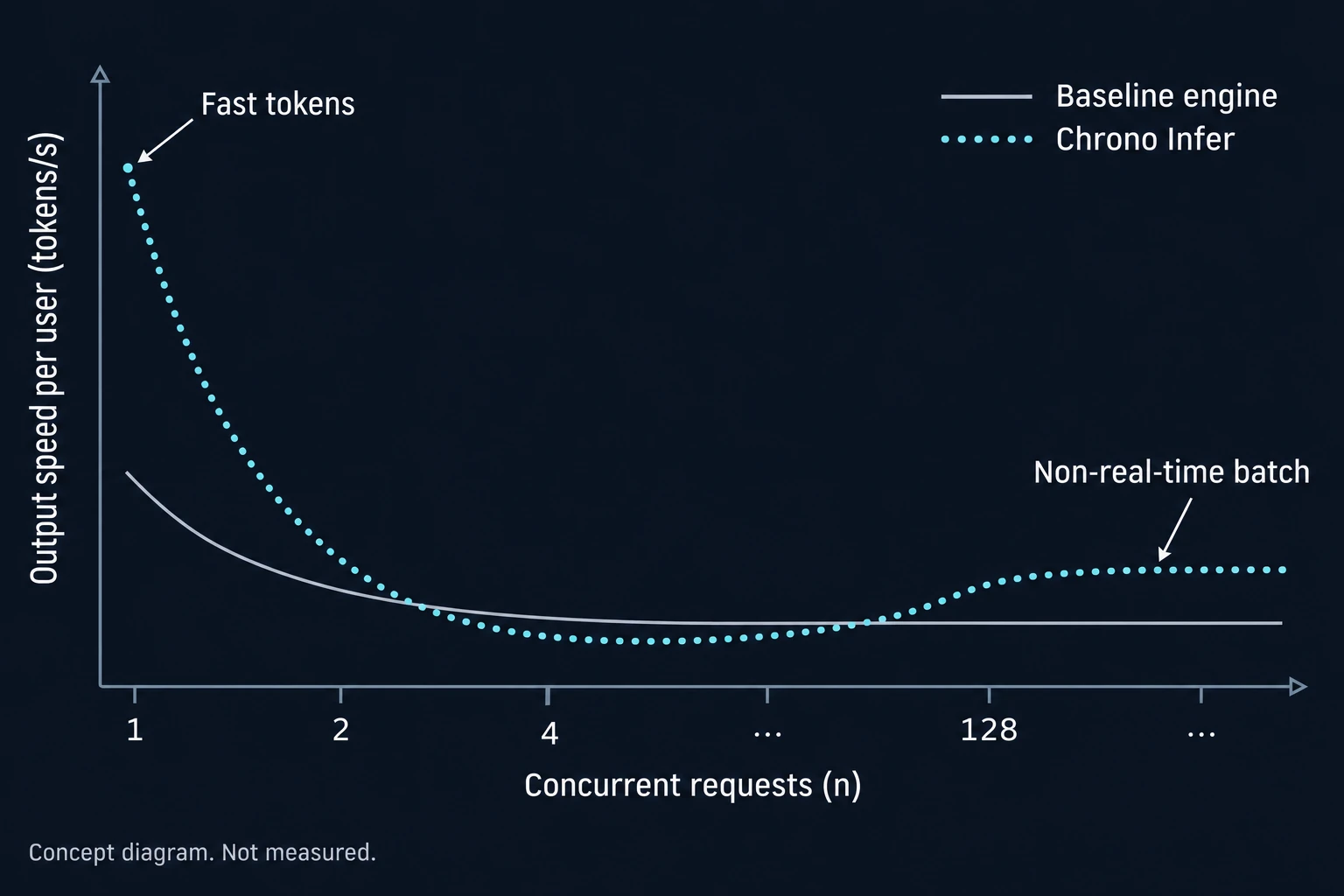
Concept diagram: output speed per user against concurrent requests. Chrono Infer starts far above a baseline engine at one request, dips slightly below it in the middle range, and levels off above it beyond 128 requests.
Design intent for small and large batch. In the middle range the baseline engine is faster. Measured results will replace this figure.

Two ways to buy tokens

Small batch

Fast tokens for one user

Interactive agents, coding assistants and voice loops wait on every token. Chrono Infer gives each request a fast decode path, so long reasoning finishes inside the response window.

  • Agents and tool loops
  • Coding assistants
  • Real-time chat and voice

Large batch

High volume for batch jobs

Evaluation runs, data generation and offline pipelines care about total throughput, not one user. Chrono Infer packs large batches to deliver more tokens per GPU-hour.

  • Offline evaluation
  • Synthetic data and distillation
  • Document and log processing

Switch in three values

Keep your OpenAI SDK. Change the base URL, the key and the model id.

  1. 1Base URL. Point your OpenAI client at the Chrono Infer endpoint.
  2. 2API key. Use the key issued with your token plan.
  3. 3Model id. Pick a hosted model. Your prompts and code stay the same.
from openai import OpenAI

client = OpenAI(
    base_url="<chrono-infer-endpoint>/v1",
    api_key="<your-api-key>",
)

stream = client.chat.completions.create(
    model="<model-id>",
    messages=[{"role": "user", "content": "Plan the next step."}],
    stream=True,
)
for chunk in stream:
    print(chunk.choices[0].delta.content or "", end="")
Example with placeholders. Endpoint and model ids come with your plan.

Talk to us about a token plan

Tell us your model, your traffic shape and your latency target. We size a fast-token or batch plan around it.

Start an enquiry